Friday, January 25, 2008

Hail YES, We Have Weather in California!

Earthquakes. Mudslides. WildFires. Tsunamis. Floods. Pestilence (okay, likely no worse than anywhere else). All Biblical-type horrors for which California has worked hard to earn proper title. Even snow. BIG resorts around Tahoe and Mammoth, and even in the San Gabriels above LA there is enough snow to ski. [Isn't that just the best? SKI resorts so close to SURFING?!!?]

But HAIL??? Which requires THUNDERSTORMS??? Hardly ever ever in California. Locals will find conversation in a thunderstorm for days.

Yesterday, 24Jan08 I was dead asleep in the very early morning hours, and was snapped awake by one of those lightning flashes that pierces your eyelids - followed a second later by a sharp loud and CLOSE clap of thunder. Peeking outside at 1:45am and thinking I would see who-knows-what...


THIS is the exact 'real-time' view from the door of 'The Bunkhouse' (our name for our 1966 14' Aristocrat Traveleer-more on that in a future post).


While this may look like snow... it is HAIL. About the size of peas.

This is the shed where we store firewood for sale to campers. The white dots in the photos are falling hail.


Grabbing my camera the next morning, I left the chilly (48 degrees) Bunkhouse and was surprised to see so much hail still on the ground seven hours later.


The views over the water at El Capitan State Beach (where we live) were stunning. Ice. Fire. Water. = Hail. Sun. Ocean. Powerful stuff.

Double-Crested Cormorants and Brown Pelicans gathered more closely to shore than usual, perhaps taking in the view of the 'white stuff' themselves!

Not too many people using the great picnic facilities that morning - and they missed a great view.

The hail even piled up in wind-blown drifts like snow.

The hail also stayed frozen in puddles - and this was about eight hours after it fell - so it was still chilly by SoCal standards.


These are the pellets themselves - lying on a picnic table bench.


Arriving back at the Bunkhouse about 8:30am, I found that some hail pellets had begun to take residence on our canopy - and the thermometer registers 40 degrees!


By the time I hit the road to see 'snow-on-the-mountains' above Santa Barbara, the clouds had settled back in, covering up much of the earlier sun-lit drama. However, for snow to appear here, the 'snow level' has to be at 2,000' elevation or lower. For snow to form the air must be quite cold for 'Sunny Southern California' - something you are not likely to discover in any brochures from our wonderful and local Chambers of Commerce!

Many thanks to the the Canyon Market gang at El Capitan Canyon for sharing their great WiFi that allowed for pleasant production of this post. I can also vouch for their moist & tasty carrot cake! This environmentally sensitive upscale cabin, yurt & safari-tent resort is located just across 'the 101' from El Capitan State Beach.

This is the view I had of El Capitan Creek and Western Sycamores (complete w/laptop at right) from my blogging seat inside the Canyon Market & Deli.

Monday, January 21, 2008

California Condors & Gray Whales!!

Birthdays - who needs 'em - and what in the world do you ever get someone for a birthday present? And not having any expectations for gifts myself - just about anything might be a surprise. Well, my birthday was yesterday, and I received GREAT present(s), and other than some travel-time today, there was not a cent involved!

Living at El Capitan State Beach, I have been very interested in trying to view whales from shore. While it may be much more satisfying to take a 'whale boat' (not the ones from Japan that are dodging 'green' ships in the Antarctic Ocean) and have professionals guide you to see these mammoth marine mammals, finding them yourself is just more satisfying. And saves $80 - each.

Yesterday, while walking along the picnic area above the beach, I saw a young family looking out to sea - and quite intently given that there were very young kiddos involved. Mom had spotted a whale, and they were all waiting for another 'blow'. I weaseled my way over and inquired as to their focus, and they kindly pointed me in the right direction. So Sunday morning, before the NFL Conference Championships, I had my first whale sighting from land. A gray whale, headed south to the Gulf of California for the annual winter gathering. I'm told by the lifeguards here who have a GREAT viewpost, that I can expect to see many more gray whales beginning in mid-February when the moms come northward, closer to shore, keeping junior shore-side while she provides some protection to the roving white sharks and killer whales. I might see several dozen Gray Whales a day!

I am quite fussy about the quality of photos that I post on this site. However, I am pleased to offer the big lump that represents a mature Gray Whale:

So, what does one do on the day following the Gray Whale-from-the-beach adventure? How about trying to see a California Condor? Having seen Reed Smith's posting in the Ventura County Birding site stating that he had seen CA Condors that very day, Jeanne and I decided to give it a try.

Lake Piru is about 80 miles to the east and north of the Santa Barbara area and is located in Ventura County. In spite of clouds and a chance of rain, we headed to Lake Piru. Arriving about 9:45am, we stopped as outlined in the posting at the pull-off just above the dam. Moments later, Kirk and Luke from Malibu stopped in, also having read Reed's post - looking for CA Condors. We looked together, both pleased for the good company for nearly a half-hour, while Kirk bottle-fed Luke (Luke is a budding birder at four months old).

Coming up empty, we both headed to new overlooks, with Kirk and Luke going on ahead into the $8/car Lake Piru Management District. Jeanne and I decided to forego the extra $8 and return to the first overlook - and were rewarded for our thriftiness! Jeanne has become an excellent "bird-spotter" and spied the soaring birds over a ridge to the west. While far from being right overhead, and moving farther westward, I was able to take some photos. Again, while not 'quality photos', they do CONFIRM that we saw California Condors at Lake Piru!

Now that's a great 'back-to-back': 45 tons of Gray Whale on 20Jan and the 9' wingspan of CA Condors on 21Jan. Now let's see... what shall we look for tomorrow???

Strong white coloration on the leading edges of the underside of the wing, plus a white spot in the center of the underside of the tail are diagnostic. [Turkey Vultures are about half the size of CA Condors and have black leading edges & white secondary feathers.]

This view shows that the head is without feathers and has red skin.


We saw a pair.

Typical dihedral shape of California Condors - disappearing to their Sespe feeding grounds.

Thursday, January 17, 2008

A New Year at El Capitan State Beach

The beginning of a New Year can't happen until the old one is finished. This year finds Jeanne and me still in Santa Barbara County, thirty miles west (northward on the 101) of the Rincon where we were so fortunate to 'over summer' in an apartment of most-generous friends, our 'housing benefactors' as I described them to others.

We are now official State of California Campground Hosts at El Capitan State Beach - and still seeking our next adventure - and being certain to enjoy THIS adventure in the meantime! More on the search in another posting.

Always a bit of 'a naturalist' since my youth without television in St. Pete, FL, my work over the past twenty years has taken me more inside the office and in front of the computer. Over the past ten months I have had much more flexibility to be in nature and have reveled in that opportunity. I hope I do not lose that natural connection to a new adventure.

This photo shows the very last flash of sunlight on the very last day of 2007. Looking westward over the Pacific on El Capitan Beach, the foreground is busy with the 'cairn work' of holiday campers. Sort of Stonehenge-like, I think.

Now looking to the eastern sky, the 'rock people' welcome the very first light of 2008 at El Cap State Beach. These celestial bookends celebrate a coming and a going of time at the turn of a New Year.

Wednesday, January 16, 2008

The Mae West of Trees?? Well, close...

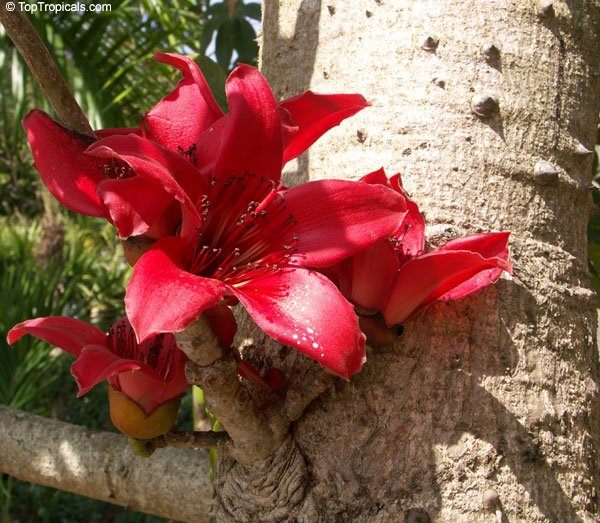
Seems to me like Mae West would be VERY proud to be associated with this Floss Silk tree - or the Kapok tree. Both are very large, very showy and can surprise you with thorns! The flowers are brightly colorful, and appear as the leaves are dropping at the onset of the dry season (fall in the warmer parts of the Northern Hemisphere).
The brilliant flowers are large, to nearly 5" across and can carpet the ground when in full flower. In the same Order as Hibiscus, the Bombaceae or Bombax Family is mainly a tropical and Southern Hemisphere group of plants, with some trees of bizarre shapes and sizes.


There are many 'cultivars' of the Floss Silk Tree that include several different colors. This unusal tree is located on property once owned by Sumida Nurseries in Santa Barbara, California and is not only an older tree, it was grafted with at least three different flower types! In the news today, the Sumida Nursery Property is undergoing changes of its own. Let's hope the developers respect the most superior of Sumida plants.

But back to Ms. West... and the connection to this odd tree. You may recall a type of life vest used in the first half of the 20th Century? First used at the time of Ms. West's prominent career, sailors wearing this bulky vest felt they immediately had added girth above the waist to match the shape of the legendary Mae West. It is the silky fibers in the ripening fruit or pod that were used in making the flotation vests. These fibers were naturally coated in an oil and encapsulated the air within the fibers. Only if the cover of jacket was punctured could it fill with water and fail. This type of flotation was later superceded by much more dependable foams.

Flower closeups


And just where would the 'thorniness' occur? Varieties have been found or selected for use in landscapes that have very few if any thorns - for obvious reasons. This variety is nearly thornless a few feet above the ground.


Small thorns can be seen near the ground, as well as a carpet of fallen flowers.
THIS is why thornless varieties are popular in personal landscapes! Personally, I very much favor the striking (ouch!) look of the thorns of Chorisia speciosa. The thorns are very much a part of the tree's character and identity.

Can you see the nickel slipped in next to a large thorn? That will give you some idea of the size of the thorns! These are some SERIOUS thorns! The bark itself is also unusual in that it is green - an adaptation that allows for some photosynthesis to occur even after the leaves have fallen. Clever, eh?


In every way but ONE, this would be a great climbing tree. However, that ONE way is truly the end of that idea!


So thanks to the fibers in the fruit of a tree native to southeastern South America, lives have been saved at sea, snuggly wrapped in the embrace of Ms. West!


Friday, January 4, 2008

Zaca Fire Out, and the Effects Linger Still


When I last wrote about the Zaca Fire 16Sept07, this huge fire was contained, and not yet out. While today's heavy rains, in addition to 2"+ of rain of two weeks ago has the fire out the fire is still causing problems.


Many of my friends in Santa Barbara, Montecito and Carpinteria have reported huge amounts of Zaca Ash being deposited on their homes, patios, decks and cars. The culprit? Sundowner and/or Santa Ana winds. These strong winds pick up the ash on the ground left from the Zaca Fire and can deliver it for dozens of miles downwind. From my new home in El Capitan State Beach 15 miles west of Santa Barbara, I could see the dark cloud extending into the Santa Barbara Channel all the way past the Channel Islands - 25 miles to sea to the south.


The photo above was taken a bit closer than El Cap State Beach, from Goleta near Atascadero Creek overlooking a remnant patch of agricultural land. Streets in Santa Barbara have looked like the "Old West" with dust being kicked up by passing cars. Today's rain should settle the dust, and wash it out to sea.


Thursday, November 8, 2007

Beach Houses AVAILABLE on the Rincon!!

YESSIRRRREEEEE!!! Step Right Up! Waterfront Beach Property!! Build up Sweat Equity. Choice of Lots. Innovative and 100% Green for the Planet. Building Materials already onsite - free!

No, NOT those common ol' fully finished homes set waaay back from the beach. We're talkin' ON THE FREAKIN' BEACH!


Be sure to get in on the ground floor in this popular development between Rincon @ the 101 and Rincon Point County Park. Some new homesteaders have already made impressive starts.


Others a more modest beginning.


Or maybe this is just planned to be a weekender?


Or a cabana!

Now these folks are well set up for a good time on the Rincon!

However, the Rincon Beach House is nearly eligible for 'Landmark Status' and has been used for years. Sited pleasantly close to both the Parking Lot and the Cove it is a favorite of Rincon Surfers.

Here this venerable and most desirable property is modeled by a local Beach House Bum.

Wednesday, November 7, 2007

Rincon Skies -- a recurring series -- #First


Our planet is made of rock, water and air - the basic ingredients for life as we know it. I feel that we all are connected - whether we choose to be an active participant or not - to these three elements. Many of my "Rincon Skies" photos will feature all three: above is the Pacific Ocean at low tide, exposing rocks and in the air are particles from the SoCal fires of late October. The late afternoon sun - still a couple hours before 'sunset' causes the particles to refract the light in exciting ways... an ironic byproduct of the horror known by too many in Southern California. Above, a surfer enjoys the shape of the water, avoids the rocks and hopes the air in his lungs is not too unhealthy.


The photo above was taken a day earlier (21Oct07) from the others in these first five photos (the other four were all taken the same day, 220ct07). Early effects of the soot from the SoCal fires have already reddened our sunsets. Carpinteria is located in the previous link in the eastern edge of the northernmost swirl of smoke. The closest fires to Carpinteria were the ones in Ventura County, and located about 45 miles to the east and a bit to the north.


With the soot and ash and smoke settling in, these photos show true reds of the afternoon of 22Oct07.


After displaying a glowing red sun for several hours, sunset approaches.


This photo was taken earlier in the afternoon about the same time as the very first photo. The sun will still not 'set' for three hours.


Not ALL of the "Rincon Skies" series will be particularly colorful. The darkness in mid-afternoon is also the result of a fire - this summer's huge Zaca Fire. Although the fire was contained by mid-September07 - as I wrote earlier in this blog, it was only declared controlled on 29Oct07. At the time of the photo (12Oct07) it was still burning. However, the black in the photo is a result of 'sundowner' winds similar to santa anas that were strong enough to pick up the burned ash and blow it 25+ miles over Santa Barbara and the Channel Islands. The dots on the horizon are oil rigs, five miles+ offshore.


This photo and the four following are all mostly 'natural' in that there was little extra particulate matter blowing around from the soot of fires months ago, or the smoke of current fires. Just nature: sun, water vapor in clouds and the Pacific to make a picture - oh, and the Mexican Fan Palm, Washingtonia robusta just to add a semi-tropical flavor.


The mouths of local creeks form sloughs where fresh/brackish water stands for long periods - even through our long, long Mediterranean-climate summer. During the wet season (Coming up anytime soooon? As of today, there has been very, very little rain this fall. Less than 1/2 inch.) these creeks run right through the beach sand and empty into the Pacific. During the dry season wave action piles up beach sand and closes the creeks, forming standing water. This is Carpinteria Creek in Carpinteria State Beach, where I have recently seen Eared Grebes, Black-crowned Night Herons, Coots, Mallards, Gulls by the score, Snowy Egrets, White Herons, Great Blue Herons and a Northern Shoveler. The quiet brackish water seems to suit them.

Sunset from the bluffs above Carpinteria State Beach, near the Oil Pier that services the oil rigs.

Setting the tone for "Rincon Skies", I want to be sure that skies other than sunsets are expected as well!


Sulfur Fungus III (& final installment, I promise!)

About four days after my last post on the Missing Montecito Mushroom.... I spied yet ANOTHER Sulfur Fungus! This time about 12 miles eastward, down the coast in Carpinteria - in fact at Carpinteria State Beach. This one appeared to be growing directly from the ground, as evidenced above. Note my key and 'clicker' for a hint of how big this sucker has grown.


This side view gives you an idea about the layers invovled, and you can see that this specimen is showing its age - with scuff marks from branches falling from above and the darker, clearer orange below.


In fact this is a MOST SPECIAL Sulfur Fungus. It's being featured as a landscape planting in the median! And you must admit, it's the most colorful and interesting form of life in sight!

My sleuthing has determined that in fact this fungus is also growing on eucalyptus - just like its Montecito brethren. Only this eucalyptus died long ago, leaving only the stump below the soil line - yet the remains are more than enough to sustain an actively growing Laetiporus gilbertsonii.

This individual apparently is well past the 'chicken of the woods' phase as the roadway that it divides connects the main camping areas at Carpinteria State Beach - and with all those cooking fires and hungry local surfers, you'd think it would have made it into a stew pot. Or not.

Monday, October 15, 2007

Sulfur Fungus "Missing in Montecito"?!?

UPDATE!!!
Case of NO FUNGUS AMONGUS; Or perhaps FUNGUS INNUS?

Driving past the site of my previous blog (below) just four days later, the entire bowling ball sized Sulfur Fungus was oddly missing. Another quick turnaround, and closer inspection revealed that the entire mass had been removed from the tree - likely headed to the kitchen of an alert driver on East Valley Road in Montecito.

While these pieces on the ground were all that was left, along with a few 'hangers-on' on the tree itself, it hardly seemed enough to make another meal, so I returned to the car empty-handed, amused that someone had some good 'shrooms in 'em (innum?)

Thursday, October 11, 2007

Fungus Amongus in Santa Barbara

This bright yellow and orange shelf fungus caught my eye at 30mph on earlier today about a mile and a half east of San Ysidro Rd. on East Valley Rd., Santa Barbara (CA-192). As big as a bowling ball, and about a foot and a half above the ground, the Sulfur fungus, Laetiporus sulphureus has likely been growing in the large eucalyptus tree (one of a long line along the road) for a very long time - perhaps as many as forty or fifty years. [October 16: Daniel Mosquin of the University of British Columbia Botanical Garden publishes a great feature, "Botany Photo of the Day". He has provided additional information regarding our fungus and identifies it as Laetiporus gilbertsonii. Thanks, Daniel for the updated ID and for accepting my photo/info at BPOD. I read "Botany Photo of the Day" every day and recommend it highly!]

Upon closer look, you can see the small, bulbous lumps of regrowth that have covered many old wounds. And growing so close to the edge of the roadway, there are many opportunities for wounding. Once the wound is inoculated by a tiny spore, the fungus grows throughout the heartwood, and only matures to this 'fruiting' phase after many, many years.


Darn! Something this brightly colored looks like candy! Although apparently it tastes more like chicken. As with all fungus/mushrooms, double/triple check for identification and suitability prior to eating. Even if edible, some people have reactions to them - so only eat a small piece the first time around. One way to prepare shelf fungus (and only collect when fresh, not old and brown) is to roll pieces in beer batter and fry them up - and with that recipe, you can even make shoestrings taste good!